

For most of its history, a hospital was a place. Care happened inside its walls, records lived in its basement, and the patient's relationship with medicine began at the registration counter and ended at discharge.
That model is dissolving. Modern healthcare is becoming an ecosystem — a mesh of hospital platforms, patient apps, national digital infrastructure, diagnostic networks, insurers, and intelligent services that follow the patient wherever they are. The hospitals and health-tech builders who understand this aren't digitising the old model; they're constructing a new one, layer by layer. Companies like HLTHTek — building an integrated hospital platform, a patient companion app, and the connective tissue between them — offer a useful lens on what that ecosystem actually looks like.
The hub: an integrated hospital platform
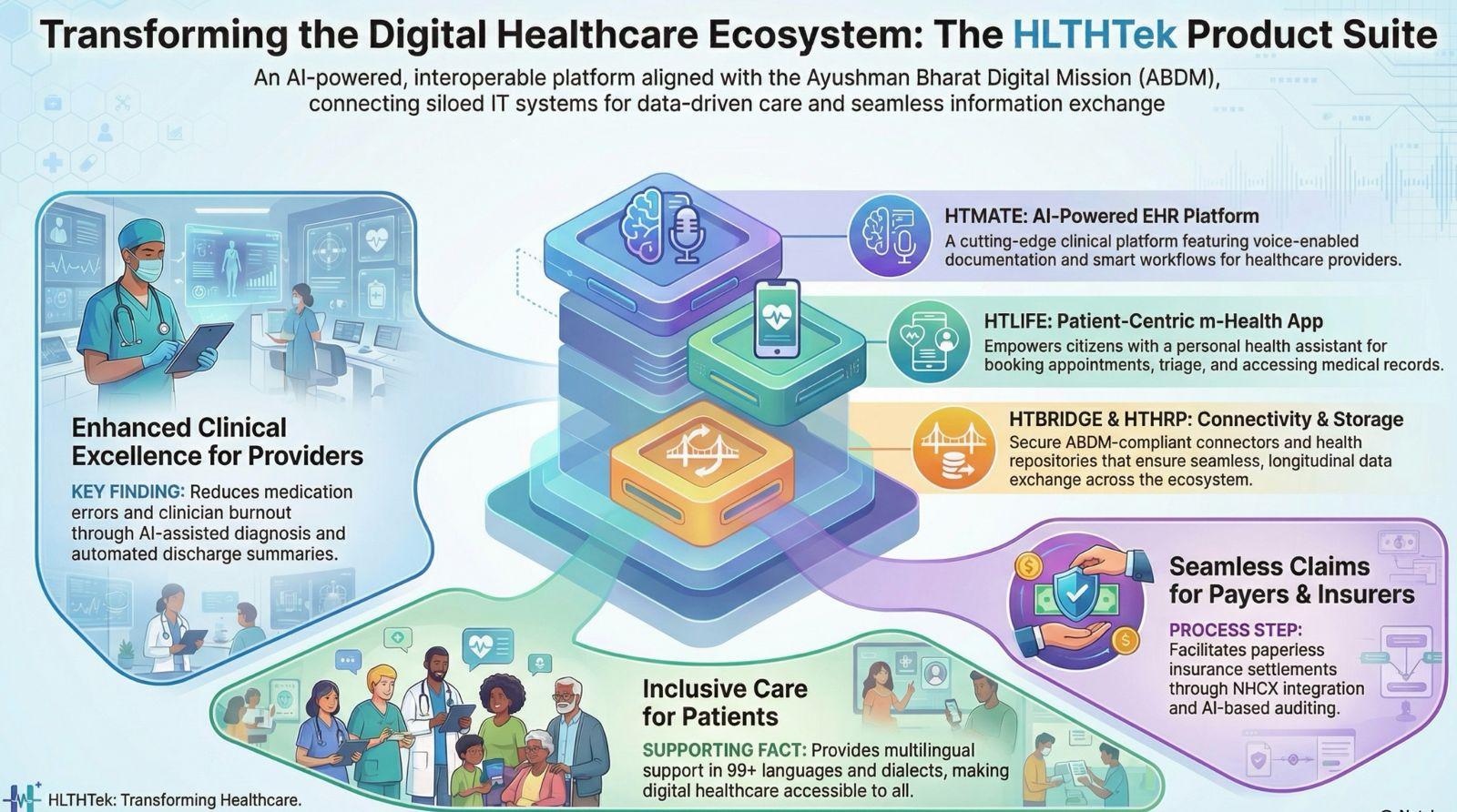
Every ecosystem needs a centre of gravity, and in healthcare that is the hospital's own operating platform — the HMIS. Not the old sense of the word (a billing system with attachments), but a true platform: one master data layer for departments, doctors, wards, beds, services, and tariffs; role-based workflows for everyone from the radiologist to the store keeper; and OPD, IPD, lab, pharmacy, inventory, and billing running as one continuum on a single patient record.
This hub matters because everything else in the ecosystem plugs into it. HLTHTek's HTMATE platform — running across 20-plus hospitals — is built on exactly this premise: the hospital's clinical and operational truth lives in one place, structured and complete. A patient app, a national health registry, an AI assistant, or an insurer's claims pipeline can only be as good as the hub that feeds it. Fragmented data in, fragmented ecosystem out.
The patient layer: care that leaves the building
The second layer of the ecosystem lives on the patient's phone. Companion apps extend the hospital's platform outward — registration, appointments, care plans, orders, reports, and teleconsultation, all drawing on the same record the care team uses inside the hospital.
The design insight is to start where continuity matters most. HLTHTek's HTLIFE app launches with oncology — where a missed follow-up can change a prognosis — before extending to maternity and diabetes care. A cancer patient's journey spans months of cycles, scans, and reviews across multiple visits; an app that carries the care plan, prompts the follow-up, and opens a teleconsult when travel isn't possible turns that journey from a series of disconnected episodes into one supervised continuum.
This layer changes the economics of engagement too. Follow-up compliance stops depending on phone-call rosters. Patient questions get answered before they become anxious walk-ins. And the hospital's relationship with the patient persists between visits — which is where loyalty, outcomes, and lifetime value are actually built.
The national layer: ABDM as the connective fabric
No hospital ecosystem in India exists in isolation anymore. The Ayushman Bharat Digital Mission has laid national rails — ABHA health accounts that give every citizen a portable health identity, the Health Facility Registry, FHIR-based record exchange, and digital claims infrastructure — and these rails are what let one hospital's ecosystem talk to everyone else's.
For the modern platform, ABDM readiness is not a checkbox; it is the passport to the wider network. An ABHA-linked record created in one facility becomes visible, with consent, wherever the patient goes next. Claims move digitally. Government schemes and insurers plug in natively. The DPDP Act adds the trust layer — consent management and auditable data handling — that makes patients willing to participate at all.
The practical consequence: an integrated HMIS and its patient app stop being a private ecosystem and become a node in a national one. That is where the compounding value lies — every connection the platform supports multiplies what the hospital can offer.
The intelligence layer: AI and continuity of care
The newest layer of the ecosystem is intelligence — and it only works when the layers beneath it do. AI assistance in healthcare takes many forms: summarising a long treatment history before a consult, flagging patients overdue for follow-up, drafting documentation, triaging patient questions in an app, surfacing risks buried in structured data.
Every one of these depends on clean, connected records. An AI assistant reading a fragmented paper trail is guesswork; one reading an integrated, structured record spanning hospital and home is a clinical instrument. This is why ecosystem builders wire AI into the platform and the patient app together — the intelligence follows the data, and the data now flows across the whole care journey.
Telemedicine completes the loop. When the consult, the record, the care plan, and the AI assistance all live in one connected system, the distinction between an in-person visit and a virtual one becomes operational, not clinical. Continuity of care — long healthcare's most broken promise, especially for chronic and long-course conditions — becomes an engineered property of the ecosystem rather than a hope.
What an ecosystem builder looks like
The HLTHTek approach illustrates the pattern worth copying, whoever builds it:
- Platform first. Get the hospital's own house in order — one integrated HMIS, deployed and proven across real facilities — before layering anything on top. The ecosystem is only as strong as its hub.
- Extend to the patient deliberately. Launch the companion app where continuity matters most and the clinical case is sharpest, learn there, then broaden to the next specialties. Depth before breadth.
- Build on national rails. Treat ABDM, ABHA, and digital claims as native infrastructure, not integration projects — so every deployment is born connected to the wider network.
- Partner with clinical institutions. Ecosystems aren't built in software offices alone. Co-developing with hospitals and specialist institutes — clinicians shaping the workflows, technologists shaping the platform — is how digital tools end up fitting real care instead of an imagined version of it.
The common thread is sequencing: hub, then patient layer, then network, then intelligence — each layer feeding the next.
Joining the ecosystem
For hospital leadership, the strategic question has quietly changed. It is no longer whether to digitise — that argument is over — but whether your digital foundation can participate in the ecosystem now forming around it. A standalone system, however modern its screens, is a dead end: it can't feed a patient app, can't speak to national rails, can't power AI, can't extend care beyond the gate.
An integrated platform, a patient layer, national interoperability, and intelligence on top — that is what the digital ecosystem for modern healthcare looks like. It is being assembled right now, hospital by hospital. The institutions that join it early will define what care in India feels like for the next generation. The ones that wait will find the ecosystem formed without them — and their patients already in it.